20.11.2026
Minor movements continue at Svínafellsheiði
- Minor movements continue to be detected at Svínafellsheiði.
- GPS measurements collected during a field visit on 12 November are consistent with measurements from the monitoring system.
- The hazard to inhabited areas is currently considered low.
- The Icelandic Meteorological Office does not recommend visiting Svínafellsjökull in the near future.
During the past week, data collected during a field visit to Svínafellsheiði on 12 November were processed. Displacements measured at survey points during the visit are consistent with measurements from the GPS stations, within the margin of measurement error. Two GPS stations and three extensometers monitor the slope and transmit data in real time.
During the field inspection and in the drone imagery, fractures were observed in the lateral moraine below the fracture zone. These fractures are likely located in loose material and are unrelated to the fractures in the bedrock. No other changes to the ground surface were observed.
Displacements Since Late September
Since late September, the lower GPS station (SVIN) has moved 4 cm towards the north-northwest, downslope, and subsided by 6 cm. The upper GPS station (SVIE) has moved 2.5 cm towards the north-northwest, with almost no vertical displacement recorded.
Measurements from the extensometers are consistent with the movements recorded by the GPS stations. The extensometers measure changes in the distance between survey points on either side of the main fracture.
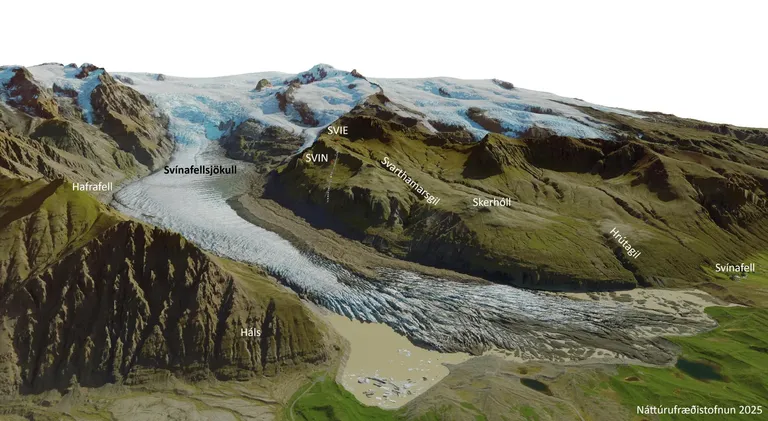
3D visualisation of Svínafellsheiði and Svínafellsjökull. The image shows the main fracture, the landslide debris that fell onto the glacier in 2013, and the locations of the GPS stations in the upper (SVIE) and lower (SVIN) areas. Image: Icelandic Institute of Natural History, 2025.
Causes of the Movements Remain Unclear
Movements at Svínafellsheiði were negligible from 2018 until clear movements were detected again this autumn. Glacier thinning in recent years and the gradual forward movement of landslide debris in front of the fracture zone are among the possible explanations for the renewed movements. The landslide debris fell onto the glacier in 2013.
The area's hydrological conditions may also play a role. Precipitation can raise groundwater levels and increase water pressure within fractures, potentially reducing the stability of the rock mass. The movements are likely to result from a combination of several factors.
Continued Monitoring of Movements and Precipitation
The Icelandic Meteorological Office continues to monitor the area and keep track of weather forecasts. Particular attention will be paid to whether movements on the slope change if temperatures rise and rainfall occurs.
Harsh weather conditions at Svínafellsheiði can make the operation and maintenance of the monitoring system challenging. Snow, icing and strong winds can affect the instruments' power supply and disrupt data transmission.
High Hazard on the Glacier if Landslides Occur
The hazard to inhabited areas is currently considered low. If a rockslide occurs in the fracture zone under present conditions, experts consider it most likely that it would come to a stop on the glacier before reaching the lagoon at the glacier's terminus.
The hazard on the glacier itself would be considerable if landslides were to occur on the slope. The Icelandic Meteorological Office therefore does not recommend visiting Svínafellsjökull in the near future.
Long-term Hazard Assessment
The Icelandic Meteorological Office's 2025 hazard assessment presents several scenarios to evaluate how the hazard could change over the coming decades. One scenario for 2070 assumes that the glacier will have thinned and retreated and that the lagoon at its terminus will have grown considerably. Under these conditions, the likelihood of a rockslide reaching the lagoon increases. If this occurs, a flood could travel downstream of the glacial lagoon. The hazard assessment is accessible here (in Icelandic).