13.11.2026
Attention
Movement continues to be detected at Svínafellsheiði
Movement continues to be detected at Svínafellsheiði, above Svínafellsjökull glacier. Over the past few weeks, the movement has remained relatively steady, although there have been occasional short pauses and periods of increased movement that may be linked to precipitation.
During a field visit this week, survey points were measured, drone surveys were carried out, and monitoring equipment was inspected. The aim was to collect additional data and ensure that the monitoring system continues to provide reliable data.
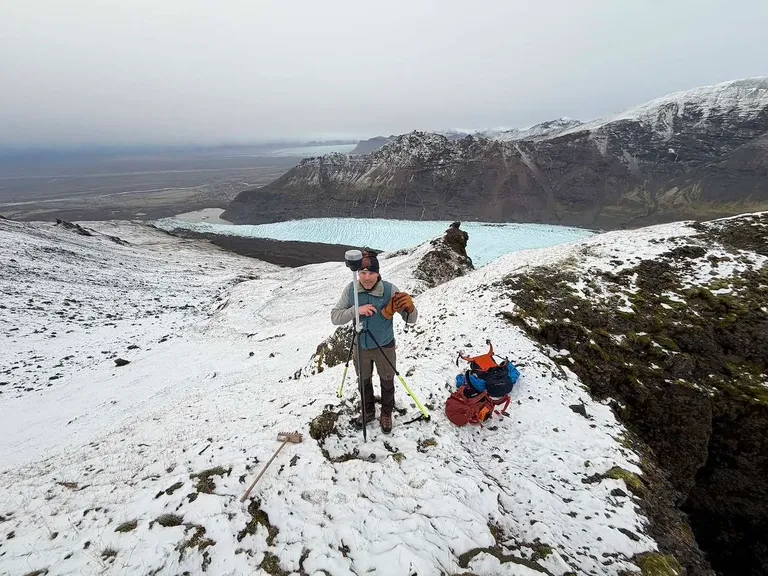
Jón Gauti Jónsson, a member of the Icelandic Meteorological Office's landslide and snow avalanche team, carrying out measurements at Svínafellsheiði on 12 November. Photo: Daniel Ben-Yehoshua.
The movements detected this autumn are the first significant movements recorded in the area since the monitoring system was installed in 2018.
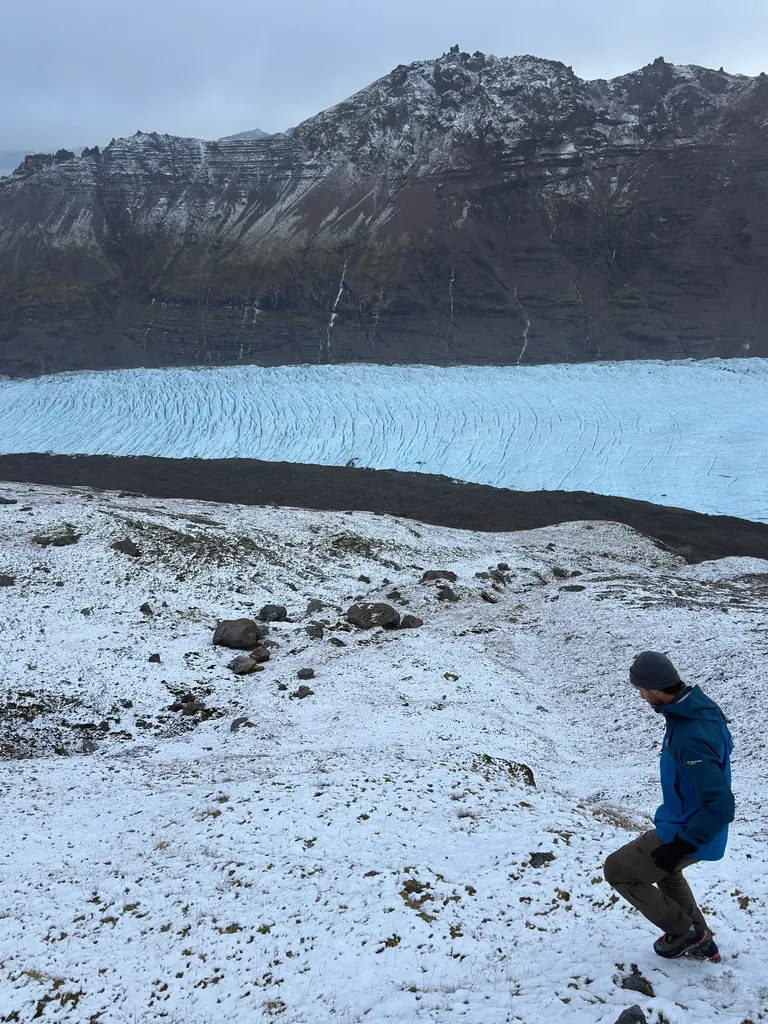
Daniel Ben-Yehoshua, a member of the Icelandic Meteorological Office's landslide and snow avalanche team, walking across the fracture zone at Svínafellsheiði on 12 November. Svínafellsjökull glacier can be seen below, along with the dark landslide debris from the landslide that fell onto the glacier in 2013. Photo: Jón Gauti Jónsson.
Uncertainty about future developments
It is not yet known how the movements will develop in the coming weeks. They may gradually subside, as happened after the fractures first opened. However, they may also continue and eventually lead to landslides.
A large rockslide is one possible scenario, but smaller sections of the slope could also collapse onto the glacier. Such landslides could still be substantial in size, even if they involved only part of the unstable area.
An increase in movement is expected before a landslide occurs, but the nature and duration of any precursory activity remain uncertain.
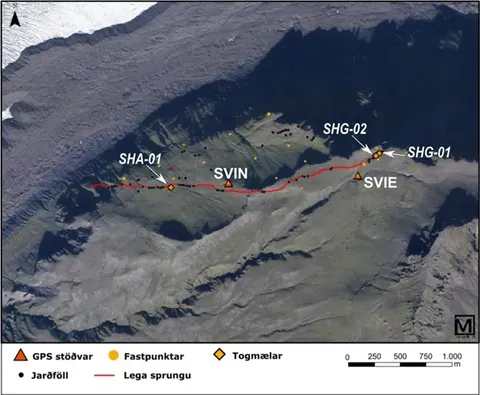
Overview map of Svínafellsheiði. The red line indicates the location of the main fracture in the slope. The locations of GPS stations, extensometers and survey points used to monitor movement in the area are also shown.
High hazard on the glacier if landslides occur
The hazard to inhabited areas is currently considered low. However, the Icelandic Meteorological Office's 2025 hazard assessment considers several possible scenarios. The most likely scenario is that a rockslide from Svínafellsheiði would come to a stop on the glacier without posing a threat to the inhabited areas below.
However, it cannot be ruled out that a rockslide could reach the lagoon at the glacier's terminus and trigger a flood that could threaten areas downstream of the glacier. The hazard on the glacier itself would be considerable if landslides were to occur from the slope.
The Icelandic Meteorological Office continues to closely monitor the area in cooperation with the University of Iceland. Monitoring data and field observations are used to reassess the situation as new information becomes available.
The latest updates on developments at Svínafellsheiði are published on the Icelandic Meteorological Office's event page, where previous updates can also be found.