27.11.2026
Continued monitoring of slope movements at Svínafellsheiði
The situation at Svínafellsheiði has remained unchanged in recent days. Small movements, on the millimetre scale, continue to be detected by both extensometers and the GPS monitoring system.
Three extensometers measure changes in the distance between fixed points located on either side of the main fracture. The GPS system provides real-time measurements of movements at two locations, also on either side of the main fracture.
The upper graphs below show the movements recorded by the three extensometers since 1 September. During the first half of September, no movements clearly associated with the widening of the fracture can be identified. The displacements recorded during this period are instead related to temperature changes. From 23 September onwards, an increase in the distance between the fixed points can be observed, indicating that the fracture is widening. However, the effects of temperature changes are still visible in the measurements.
The next graph shows precipitation recorded at the weather station in Skaftafell, the closest weather station to Svínafellsheiði. The bars represent precipitation intensity, while the line shows accumulated precipitation. Since 1 September, a total of 644 mm of precipitation has been recorded. The highest precipitation intensity was measured on 3 November, reaching 8.8 mm per hour.
The bottom graph shows air temperature recorded at the Skaftafell weather station.
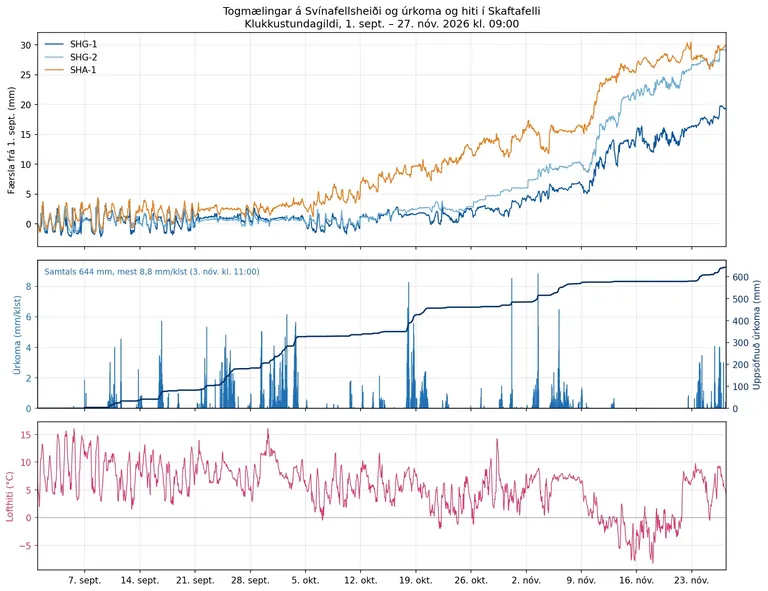
Extensometer measurements at Svínafellsheiði and weather observations in Skaftafell since 1 September 2026
Precipitation can be considerably higher at Svínafellsheiði than in Skaftafell, despite the two locations being only 7–8 km apart. Svínafellsheiði is situated at a much higher elevation, directly above the glacier, and is surrounded by high mountains.
Water pressure within the rock mass is believed to influence movements at Svínafellsheiði. Considerable precipitation has occurred in the area in recent days, and it would therefore not be surprising if an acceleration in movement is detected in the coming days or next week.
The hazard to the settlement is currently considered low. If a rockslide were to occur from the fractured area under the present conditions, experts consider it most likely that the material would come to rest on the glacier and would not reach the glacial lagoon at the glacier terminus.
There would be a significant hazard on the glacier itself if a rockslide were to occur from the slope. The Icelandic Meteorological Office therefore advises against travelling onto Svínafellsjökull in the near future.
For those interested in learning more about the area, the following scientific paper, published in recent years, may be of interest:
- “The destabilization of a large mountain slope controlled by thinning of Svínafellsjökull glacier, SE Iceland” – Read the paper.